How to do things
AI Noob vs. Pro
List biggest files
List newest files
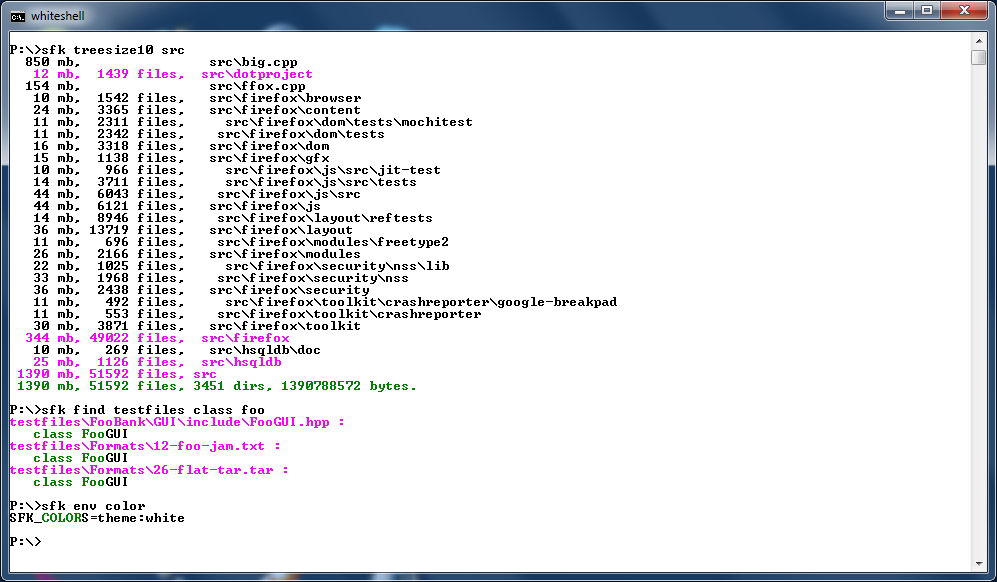
Show subdir sizes
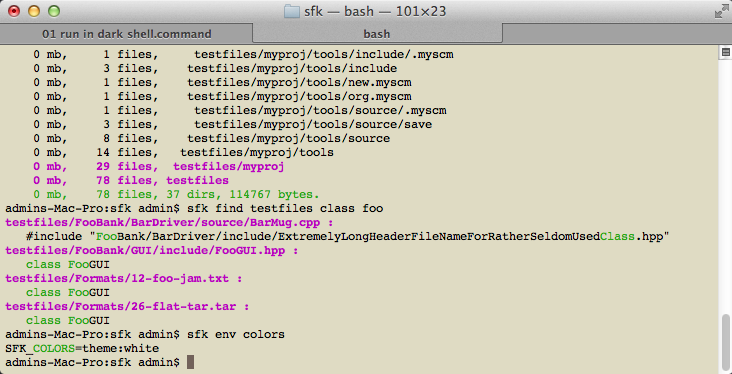
Search in files
Replace word in files
List dir differences
Send files in LAN
Free Open Source:
Swiss File Knife
a command line
multi function tool.
Depeche View
Source Research
First Steps
windows GUI
automation
command line
file encryption
free external tools,
zero install effort,
usb stick compliant:
cpp sources
articles
|

|
Swiss File Knife - A Command Line Tools Collection
Swiss File Knife - A Command Line Tools Collection
combines many functions in a single, portable executable that belongs onto every USB stick.
Search and convert text files, instant simple FTP/HTTP server, find duplicate files, compare folders, treesize, run own commands on all files of a folder - it's all within a single tool.
Read the list of highlight features.
|
|
Download SFK for Windows 64 bit here
or from SourceForge.
SFK for 32 bit (or WinXP) is available here.
You may also download the .zip file
with all binaries and source code for Windows (XP to 10), Linux and Mac,
the Intel Linux binary for 64 bits Ubuntu,
for 32 bits Intel Linux,
the binary for libc5 systems like DSL,
for 32 bits ARM Linux like on Raspberry Pi,
the macOS
i686
or arm binary.
No installation, instant use.
|
| |

|
Get the SFK E-Book!
All commands in a 300 page PDF, for convenient reading on your tablet, smartphone,
or for self printing.
Includes a 60 page tutorial for the most important functions.
|
Windows: after download, open a command line (CMD.exe) then CD into the download folder and type "sfk" for the help text. Mac/Linux: after download, open a command line or terminal, then rename to sfk like "mv sfk-mac-64.exe sfk", make it executable by "chmod +x sfk" and type "./sfk"
Intense users may be interested in Swiss File Knife Plus.
It can access https:// encrypted web URLs, and comes bundled with SFKTray Full to show 27 status lights in the system tray. Read more here.
The current version is 2.0.0.3. Read the list of recent changes here.
You may place questions in the sfk forums.
For software download sites: the SFK PAD file is available here.
SFK Icons and example code for linking can be found here.
Now follows the SFK for Windows syntax overview.
(On Mac OS X and Linux, replace every ! character by :, and every $ by #. Type wildcards
with a preceeding slash: \* and \?)
SFK - The Swiss File Knife Multi Function Tool.
(w) by J Thumm 2006-2025, swissfileknife.sourceforge.net
Release 2.0.0 Base/XD Revision 3 of Apr 12 2025.
Distributed for free under the BSD License, without any warranty.
type "sfk commandname" for help on any of the following.
some commands require to add "-help" for the help text.
file system
sfk list - list directory tree contents.
list latest, oldest or biggest files.
list directory differences.
list zip jar tar gz bz2 contents.
sfk olist - list office files in a folder,
like .docx .xlsx .ods .odt
sfk filefind - find files by filename
sfk treesize - show directory size statistics
sfk copy - copy directory trees additively
sfk sync - mirror tree content with deletion
sfk rename - flexible multi file rename
sfk partcopy - copy part from a file into another one
sfk mkdir - create directory tree
sfk delete - delete files and folders
sfk deltree - delete whole directory tree
sfk deblank - remove blanks in filenames
sfk space [-h] - tell total and free size of volume
sfk filetime - tell times of a file
sfk touch - change times of a file
sfk index - create index file(s) for fast lookup
sfk name - lookup file names using index files
sfk fixfile - change bad filenames and file times
sfk setbytes - set bytes at offset within a file
compression
sfk zip - create zip file from folder
sfk zipto - zip selected file list
sfk unzip - list or extract zip file
sfk checkzip - verify zip file content
conversion
sfk oload - load office file content as text
sfk lf-to-crlf - convert from LF to CRLF line endings
sfk crlf-to-lf - convert from CRLF to LF line endings
sfk detab - convert TAB characters to spaces
sfk entab - convert groups of spaces to TAB chars
sfk scantab - list files containing TAB characters
sfk split - split large files into smaller ones
sfk join - join small files into a large one
sfk csvtotab - convert .csv data to tab separated
sfk tabtocsv - convert tab separated to .csv format
sfk encode - convert data to base64 or hex format
sfk decode - decode base64, hex or url format
sfk wtoa - convert wide chars to Ansi
sfk wtou - convert wide chars to UTF-8
sfk utoa - convert UTF-8 text to Ansi
sfk hexdump - create hexdump from a binary file
sfk hextobin - convert hex data to binary
sfk hex - convert decimal number(s) to hex
sfk dec - convert hex number(s) to decimal
sfk chars - print chars for a list of codes
sfk bin-to-src - convert binary to source code
sfk uuencode - encode binary files as plain text
sfk enmail -h - protect whitespace in email text
text processing
sfk filter - search, filter and replace text data
sfk ofilter - filter text from an office file
sfk replace - replace words in binary and text files
sfk xed - edit stream text using sfk expressions
sfk xex - extract from stream text using expressions
sfk xreplace - replace in files using sfk expressions
sfk run - run external command on all files of a folder
sfk runloop - run a command n times in a loop
sfk printloop - print some text many times
sfk load - load file content for further processing
sfk perline - run sfk command(s) per input text line
sfk head - print first lines of a file
sfk tail - print last lines of a file
sfk snapto - join many text files into one file
sfk addhead - insert string at start of text lines
sfk addtail - append string at end of text lines
sfk joinlines - join text lines split by email reformatting
sfk strings - extract strings from a binary file
sfk sort - sort text lines produced by another command
sfk count - count text lines, filter identical lines
sfk difflines - show text lines differing between files
sfk linelen - tell length of string(s)
search and compare
sfk xfind - search in text files using
wildcards and simple expressions
sfk ofind - search in office files .docx .xlsx .ods
sfk xfindbin - search in text and binary files
sfk xhexfind - search with hexdump output
sfk extract - extract data from text and binary
sfk find - search static text, without wildcards
sfk hexfind - search static binary data
sfk md5gento - create list of md5 checksums over files
sfk md5check - verify list of md5 checksums over files
sfk md5 - calc md5 over a file, compare two files
sfk pathfind - search PATH for location of a command
sfk reflist - list fuzzy references between files
sfk deplist - list fuzzy dependencies between files
sfk dupfind - find duplicate files by content
networking
sfk httpserv - run an instant HTTP server.
type "sfk httpserv -help" for help.
sfk ftpserv - run an instant FTP server
type "sfk ftpserv -help" for help.
sfk ftp - instant FTP client
sfk web - send HTTP request to a server
sfk wget - download HTTP file from the web
sfk tcpdump - print TCP conversation between programs
sfk udpdump - print incoming UDP requests
sfk udpsend - send UDP requests
sfk webproxy - http proxy for traffic analysis
sfk help tcp - tcp toolkit to write test scripts
sfk ip - tell own machine's IP address(es).
type "sfk ip -help" for help.
sfk netlog - send text outputs to network,
and/or file, and/or terminal
sfk fromnet -h - receive and print network text
sfk ping - ping multiple machines in one go
sfk pingdiff - find ip of new devices
scripting
sfk help chain - how to combine multiple commands
sfk batch - run many sfk commands in a script file
sfk label - define starting points within a script
sfk call - call a sub function at a label
sfk echo - print (coloured) text to terminal
sfk color - change text color of terminal
sfk setvar - put text into an sfk variable
sfk storetext - store text in memory for later use
sfk alias - create command from other commands
sfk mkcd - create command to reenter directory
sfk sleep - delay execution for milliseconds
sfk pause - wait for user input
sfk stop - stop sfk script execution
sfk tee - split command output in two streams
sfk tofile - save command output to a file
sfk toterm - flush command output to terminal
sfk for - repeat commands many times
sfk loop - repeat execution of all commands
sfk cd - change directory within a script
sfk getcwd - print the current working directory
sfk require - compare version text
sfk time [-h] - print current date and time

the Daily Landscape image

the Daily Mobile Background
SFK - The Swiss File Knife Multi Function
Tool.
(w) by J Thumm 2006-2025,
swissfileknife.sourceforge.net Release 2.0.
0 Base/XD Revision 3 of Apr 12 2025.
Distributed for free under the BSD License,
without any warranty.
type "sfk commandname" for help on any of
the following.
some commands require to add "-help" for
the help text.
file system
sfk list - list directory tree
contents.
list latest, oldest or
biggest files.
list directory differences.
list zip jar tar gz bz2
contents.
sfk olist - list office files in a
folder,
like .docx .xlsx .ods .odt
sfk filefind - find files by filename
sfk treesize - show directory size
statistics
sfk copy - copy directory trees
additively
sfk sync - mirror tree content with
deletion
sfk rename - flexible multi file
rename
sfk partcopy - copy part from a file
into another one
sfk mkdir - create directory tree
sfk delete - delete files and folders
sfk deltree - delete whole
directory tree
sfk deblank - remove blanks in
filenames
sfk space [-h] - tell total and free size
of volume
sfk filetime - tell times of a file
sfk touch - change times of a file
sfk index - create index file(s) for
fast lookup
sfk name - lookup file names using
index files
sfk fixfile - change bad filenames and
file times
sfk setbytes - set bytes at offset
within a file
compression
sfk zip - create zip file from
folder
sfk zipto - zip selected file list
sfk unzip - list or extract zip file
sfk checkzip - verify zip file content
conversion
sfk oload - load office file content
as text
sfk lf-to-crlf - convert from LF to CRLF
line endings
sfk crlf-to-lf - convert from CRLF to LF
line endings
sfk detab - convert TAB characters
to spaces
sfk entab - convert groups of spaces
to TAB chars
sfk scantab - list files containing
TAB characters
sfk split - split large files into
smaller ones
sfk join - join small files into a
large one
sfk csvtotab - convert .csv data to tab
separated
sfk tabtocsv - convert tab separated to
.csv format
sfk encode - convert data to base64
or hex format
sfk decode - decode base64, hex or
url format
sfk wtoa - convert wide chars
to Ansi
sfk wtou - convert wide chars
to UTF-8
sfk utoa - convert UTF-8 text
to Ansi
sfk hexdump - create hexdump from a
binary file
sfk hextobin - convert hex data to
binary
sfk hex - convert decimal
number(s) to hex
sfk dec - convert hex number(s) to
decimal
sfk chars - print chars for a list
of codes
sfk bin-to-src - convert binary to source
code
sfk uuencode - encode binary files as
plain text
sfk enmail -h - protect whitespace in
email text
text processing
sfk filter - search, filter and
replace text data
sfk ofilter - filter text from an
office file
sfk replace - replace words in binary
and text files
sfk xed - edit stream text using
sfk expressions
sfk xex - extract from stream text
using expressions
sfk xreplace - replace in files using
sfk expressions
sfk run - run external command on
all files of a folder
sfk runloop - run a command n times in
a loop
sfk printloop - print some text many
times
sfk load - load file content for
further processing
sfk perline - run sfk command(s) per
input text line
sfk head - print first lines of
a file
sfk tail - print last lines of
a file
sfk snapto - join many text files
into one file
sfk addhead - insert string at start
of text lines
sfk addtail - append string at end of
text lines
sfk joinlines - join text lines split by
email reformatting
sfk strings - extract strings from a
binary file
sfk sort - sort text lines produced
by another command
sfk count - count text lines, filter
identical lines
sfk difflines - show text lines
differing between files
sfk linelen - tell length of string(s)
search and compare
sfk xfind - search in text files
using
wildcards and simple
expressions
sfk ofind - search in office files
.docx .xlsx .ods
sfk xfindbin - search in text and
binary files
sfk xhexfind - search with hexdump
output
sfk extract - extract data from text
and binary
sfk find - search static text,
without wildcards
sfk hexfind - search static binary data
sfk md5gento - create list of md5
checksums over files
sfk md5check - verify list of md5
checksums over files
sfk md5 - calc md5 over a file,
compare two files
sfk pathfind - search PATH for location
of a command
sfk reflist - list fuzzy references
between files
sfk deplist - list fuzzy dependencies
between files
sfk dupfind - find duplicate files by
content
networking
sfk httpserv - run an instant HTTP
server.
type "sfk httpserv -help"
for help.
sfk ftpserv - run an instant FTP server
type "sfk ftpserv -help"
for help.
sfk ftp - instant FTP client
sfk web - send HTTP request to a
server
sfk wget - download HTTP file from
the web
sfk tcpdump - print TCP conversation
between programs
sfk udpdump - print incoming UDP
requests
sfk udpsend - send UDP requests
sfk webproxy - http proxy for traffic
analysis
sfk help tcp - tcp toolkit to write
test scripts
sfk ip - tell own machine's IP
address(es).
type "sfk ip -help"
for help.
sfk netlog - send text outputs to
network,
and/or file, and/or
terminal
sfk fromnet -h - receive and print
network text
sfk ping - ping multiple machines
in one go
sfk pingdiff - find ip of new devices
scripting
sfk help chain - how to combine multiple
commands
sfk batch - run many sfk commands in
a script file
sfk label - define starting points
within a script
sfk call - call a sub function at a
label
sfk echo - print (coloured) text to
terminal
sfk color - change text color of
terminal
sfk setvar - put text into an sfk
variable
sfk storetext - store text in memory for
later use
sfk alias - create command from
other commands
sfk mkcd - create command to
reenter directory
sfk sleep - delay execution for
milliseconds
sfk pause - wait for user input
sfk stop - stop sfk script execution
sfk tee - split command output in
two streams
sfk tofile - save command output to a
file
sfk toterm - flush command output to
terminal
sfk for - repeat commands many
times
sfk loop - repeat execution of all
commands
sfk cd - change directory within
a script
sfk getcwd - print the current
working directory
sfk require - compare version text
sfk time [-h] - print current date
and time
the Daily Landscape image
the Daily Mobile Background
| |
|
Get the SFK E-Book!
All commands in a 300 page PDF, for convenient reading on your tablet, smartphone,
or for self printing.
Includes a 60 page tutorial for the most important functions.
|

|